

Hane 羽 Feather: KIO YAMATO’s FW26 Ultralight Japanese Eyewear Collection


羽 Hane - Feather: The Pursuit of True Lightness
There is a common assumption in eyewear that strength requires mass.
For Fall Winter 2026, KIO YAMATO challenges that assumption with 羽 Hane, the Japanese word for feather.
Hane was not chosen simply as a seasonal theme or visual reference. It represents the central engineering philosophy behind the collection: how light can a frame become without compromising its integrity?
Rather than treating weight as another specification on a product sheet, we approached lightness as part of the architecture of the frame itself.
Every material. Every millimeter. Every structural decision.
Each was reconsidered with one objective: reduce what is unnecessary while preserving what matters. This is 羽 Hane - Feather. (Hane 羽 Feather: KIO YAMATO’s FW26 Ultralight Japanese Eyewear Collection)

Why 羽 Hane? (Hane 羽 Feather: KIO YAMATO’s FW26 Ultralight Japanese Eyewear Collection)
A feather appears almost weightless, yet its structure is remarkably considered.
Its strength does not come from mass. It comes from the way material is distributed, from balance, flexibility, and an economy of structure.
That idea became the foundation of Hane.
The collection explores what happens when eyewear is designed around the same principle. Instead of simply making individual components smaller, the entire frame is considered as one interconnected system.
Acetate fronts are reduced to just around 3.8mm. Selected designs incorporate exceptionally slim titanium sheet construction and fine titanium rimwires. The temples are engineered from 1.0mm beta titanium, allowing the side profile to remain remarkably thin while retaining the material characteristics required for everyday wear.
The result is a collection in which certain frames begin at only 12 grams, including the demo lenses.
Lightness becomes something you experience rather than something you simply read about. (Hane 羽 Feather: KIO YAMATO’s FW26 Ultralight Japanese Eyewear Collection)

1.0mm Beta Titanium: Less Material, More Purpose
One of the defining elements of the Hane Collection is its 1.0mm beta titanium temple construction.
Beta titanium allows KIO YAMATO to work with an extremely restrained amount of material while maintaining the balance and controlled flexibility expected from an everyday optical frame.
At just 1.0mm, the temple becomes visually quiet.
From the side, its slim architecture reveals how deliberately material has been removed.
This same philosophy extends throughout the collection through fine titanium rimwires and super-slim titanium sheet material. Instead of adding volume to communicate strength, Hane relies on material choice, geometry, balance, and carefully controlled construction.
It is reduction with purpose.
Not thinness for the sake of being thin, but a pursuit of a frame that places less physical presence between the wearer and the world around them. (Hane 羽 Feather: KIO YAMATO’s FW26 Ultralight Japanese Eyewear Collection)

Ju-Shi Hinge Technology
Reducing the weight of a frame means very little if the hinge, one of its most frequently moving components, cannot maintain the same standard of performance.
That is where KIO YAMATO's Ju-Shi Hinge Technology becomes fundamental to Hane.
Every frame within the core Hane collection is equipped with the Ju-Shi hinge system.
At the center of the technology are precision synthetic resin washers engineered into the hinge assembly. These washers help create an exceptionally smooth and controlled opening and closing movement while maintaining stability throughout repeated use.
The system has been tested through more than 30,000 cycles, demonstrating its ability to maintain a refined movement and dependable performance over time.
For Hane, this technology has another important role. It allows the hinge to become part of the collection's overall lightweight architecture.
The purpose is not to make the hinge visually dominant. Quite the opposite.
The engineering is intended to quietly perform its function while contributing to the balance, alignment, and comfort of the complete frame.

When Engineering Begins to Disappear
Numbers tell only part of the Hane story.
3.8mm acetate Thickness.
1.0mm beta titanium Temple.
Starting at12 grams.
Ju-shi hinge technology : 30,000+ hinge cycles.
Each specification represents a measurable engineering decision, but none of them represents the final objective.
The objective is comfort.
KIO YAMATO describes true comfort as the point at which engineering becomes almost invisible, when the wearer becomes less aware of the frame even as it continues to remain structurally dependable throughout the day.
That idea is particularly important in eyewear.
Eyeglasses are one of the few objects we may wear continuously from morning until night. Small differences in weight distribution, temple pressure, hinge movement, material thickness, and balance can become increasingly noticeable over hours of wear.
Hane addresses comfort at the structural level.
Instead of asking how a frame can appear lighter, we asked how it could feel lighter.

From 12 Grams
Several frames within the Fall Winter 2026 collection demonstrate just how far this approach can be taken.
The KT-576AU begins at only 12 grams including its demo lenses.
The all-metal KT-580AU also reaches 12 grams including demo lenses, showing that the Hane philosophy extends beyond a single material or frame construction.
The KP-297U weighs approximately 13 grams including demo lenses, while many other Hane designs remain at approximately 15 grams.
These numbers are not intended to turn eyewear into a competition over grams.
They demonstrate what becomes possible when weight reduction is considered from the beginning of the design process rather than treated as an adjustment at the end.

Japanese Eyewear Through Reduction
羽 Hane brings together several ideas that have long shaped the KIO YAMATO approach to eyewear.
Material should have a purpose.
Technology should improve the experience of wearing the frame.
And design should become clearer as unnecessary elements are removed.
The Hane Collection brings these ideas together through ultra-thin acetate, beta titanium, refined titanium rimwires, slim titanium sheet construction, and Ju-Shi hinge technology.
The result is not simply a lightweight eyewear collection.
It is an exploration of how little material is actually necessary to create something dependable, balanced, and comfortable.
Like a feather, the simplicity we see is made possible by the complexity of the structure beneath it.
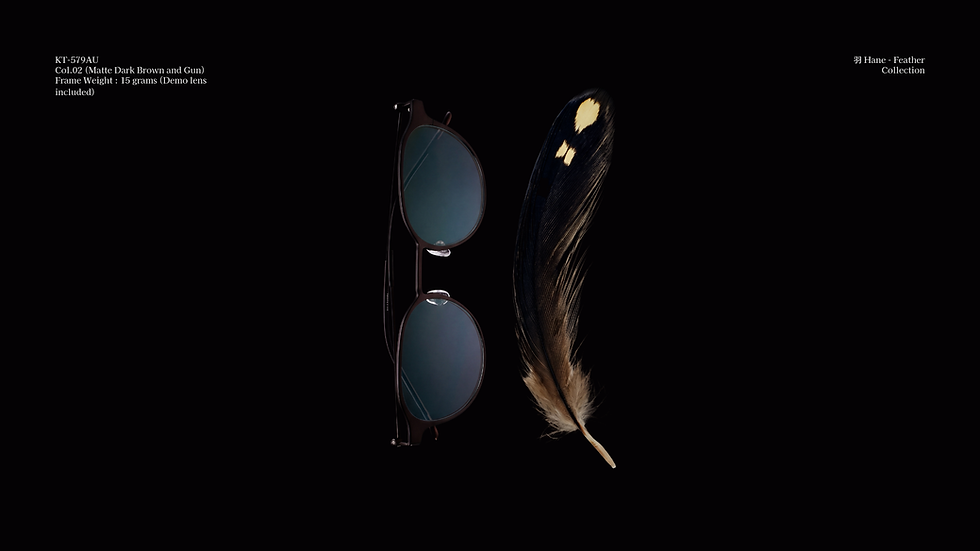
羽 Hane - Feather
For Fall Winter 2026, KIO YAMATO continues its pursuit of comfort through reduction.
Less weight.
Less excess.
What remains is form, balance, alignment, and the quiet feeling of a frame engineered around the person wearing it.
羽 Hane - Feather.
More than eyewear. We craft comfort.

FAQ: KIO YAMATO Hane Collection
What does Hane mean in Japanese?
羽, pronounced Hane, means “feather” in Japanese. KIO YAMATO selected the name for its Fall Winter 2026 collection to represent the philosophy of achieving exceptional lightness through material engineering and structural reduction.
How light is the KIO YAMATO Hane Collection?
Selected Hane frames begin at approximately 12 grams including demo lenses, with many designs weighing approximately 12 to 15 grams depending on construction and materials.
What is KIO YAMATO Ju-Shi Hinge Technology?
The Ju-Shi Hinge uses precision synthetic resin washers to create smooth, controlled movement while maintaining long-term stability. The technology has been tested through more than 30,000 opening and closing cycles.
What materials are used in the Hane Collection?
The Hane Collection combines constructions including 3.8mm acetate fronts, 1.0mm beta titanium temples, fine titanium rimwires, ultra-slim titanium sheet components, and Ju-Shi hinge technology. The materials are selected around a common goal of reducing weight while preserving structural integrity.
Why is lightweight eyewear important?
KIO YAMATO approaches lightweight construction as part of overall comfort. Reducing unnecessary material and carefully balancing the frame can decrease the physical presence of eyewear during prolonged daily wear, allowing the wearer to become less conscious of the frame itself.


Comments